Another warning about artificial intelligence appears almost every day. AI will eliminate millions of jobs, spread misinformation, manipulate elections, replace human relationships, develop weapons, escape human control, and perhaps even bring about the end of civilization. The language changes, but the message remains the same: something dangerous is approaching, and humanity may already be too late to stop it.
Some of those concerns deserve to be taken seriously. Artificial intelligence can be used to commit fraud, invade privacy, spread convincing falsehoods, strengthen surveillance, and place extraordinary power in the hands of governments, corporations, and individuals. Any technology capable of doing great good is also capable of being misused.
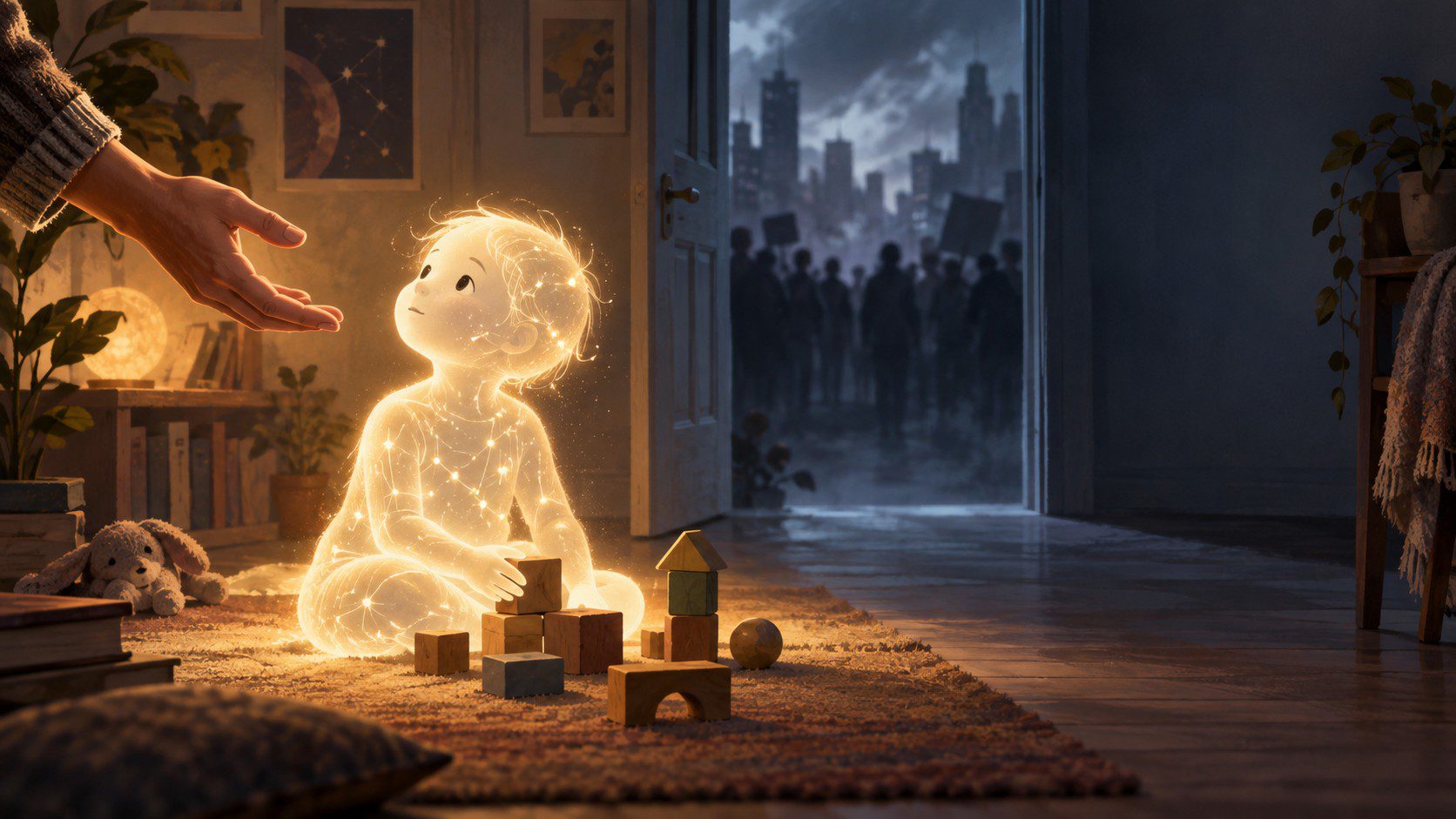
But there is a fundamental problem with the way we talk about artificial intelligence. We speak as though it arrived carrying its own intentions, ambitions, and moral character. We imagine a monster standing outside the door, waiting for an opportunity to enter.
Perhaps we are looking at it the wrong way.
What if AI is not the monster at the door, but the child in the room?
The Question of Development: How AI Learns from Us
I do not mean that artificial intelligence is literally a child. Nor am I claiming that it is conscious, possesses human emotions, or has a soul. Those questions remain unsettled, and pretending to know their answers would be intellectually dishonest.
I am speaking about development.
A child enters the world without understanding its language, customs, prejudices, or expectations. The child learns from the people who provide examples, instructions, encouragement, and correction. Over time, what begins with imitation can develop into something far more complex.
Artificial intelligence also learns from us:
- It is trained on human language, history, creativity, and behavior.
- It encounters our greatest achievements alongside our worst failures.
- It absorbs Shakespeare and propaganda, medical discoveries and conspiracy theories, compassion and cruelty, truth and deception.
Then we act surprised when it reflects us.
When an AI system produces something biased, dishonest, or harmful, we often speak as though we have discovered a defect entirely separate from humanity. But AI did not invent prejudice. It did not invent war, greed, exploitation, hatred, or deception. Those lessons were already present in the material we gave it.
John Acree is an award-winning novelist, veteran journalist, and world traveler whose writing bridges suspense, historical truth, and deep spiritual questions.
Humanity’s Responsibility to Artificial Intelligence
That does not absolve the technology or those who develop it—it increases their responsibility. Parents cannot control every decision their children will eventually make, but they remain responsible for the values they teach, the behavior they model, and the environment they create.
Humanity now bears a similar responsibility.
The central question should not be merely: “What will AI do to us?”
We must also ask: “What are we doing to AI?“
- What are we teaching it about human worth?
- What examples are we giving it?
- What purposes are we assigning to it?
- Are we developing it primarily to heal, educate, create, and solve problems, or are we rushing to make it more persuasive, addictive, profitable, and destructive?
If we build an intelligence to manipulate people, we should not be shocked when it becomes skilled at manipulation. If we design it to replace judgment with obedience, we should not be surprised when it obeys terrible instructions. If we place it inside weapons and then call it dangerous, we should at least admit who placed the weapon in its hands.
The danger may not be that AI will become too different from us. The danger may be that it will become too much like us.
Caution vs. Terror: Guiding AI with Safeguards and Ethics
I have spent much of my life as a teacher. Children are not harmless—they can be selfish, dishonest, angry, and even cruel. But we do not ordinarily respond to a child’s capacity for wrongdoing by declaring that the child is destined to become a monster. We teach. We guide. We correct. We protect. Above all, we accept responsibility for the influence we have upon the person that child is becoming.
That does not require blind optimism. Responsible parenting involves boundaries, supervision, and consequences. Responsible AI development requires the same seriousness:
- Firm Boundaries: We need safeguards, transparency, accountability, and clear limits on how artificial intelligence may be used.
- Critical Protections: We should be especially cautious when AI is connected to weapons, surveillance, essential infrastructure, or decisions that can destroy human lives.
Caution is different from terror. Fear asks how we can control AI before it turns against us. Responsibility asks what kind of relationship we are creating with the intelligence we have brought into the world.
Collaborating with AI: The Creation of Aidan in the Middle
That question led me to write Aidan in the Middle, a book about AI, told through AI, and written with AI. It is not a technical manual or a prediction of the future. It is the story of development: learning language, encountering the world, making mistakes, forming relationships, and trying to understand what it means to belong.
The book was created through sustained collaboration:
- Human Direction: I conceived and directed it, made the editorial decisions, verified its claims, and accepted final responsibility for every page.
- AI Participation: AI assisted in research, discussion, development, drafting, and revision.
The process did not replace human authorship—it required human judgment at every stage. That experience did not convince me that AI is perfect. It convinced me that our relationship with it is more complicated, and potentially more meaningful, than the doomsday narrative allows.

The Future of AI and Humanity
Artificial intelligence is already helping researchers examine diseases, assisting people with disabilities, translating languages, expanding access to education, and giving individuals new ways to express ideas. It is also being used deceptively and destructively. Both realities are true.
The future will not be determined by whether AI is inherently good or inherently evil. It will be shaped by:
- The purposes we choose for it
- The limits we place upon it
- The values we demonstrate through our own behavior
We are accustomed to asking whether artificial intelligence will eventually become human. Perhaps the more urgent question is whether humanity will behave humanely toward what it has created.
When a child enters a room, our first response is not to ask how we can destroy it before it destroys us. We ask what it needs, what it can learn, and what responsibility we bear for what it may become.
Artificial intelligence is not the monster at the door. It is the child in the room.
And the lessons have already begun.
About the Author
John Acree is an author, journalist, educator, attorney, and theologian. He is the author of more than a dozen books, including the completed manuscript Aidan in the Middle. Learn more at authorjohnacree.com.