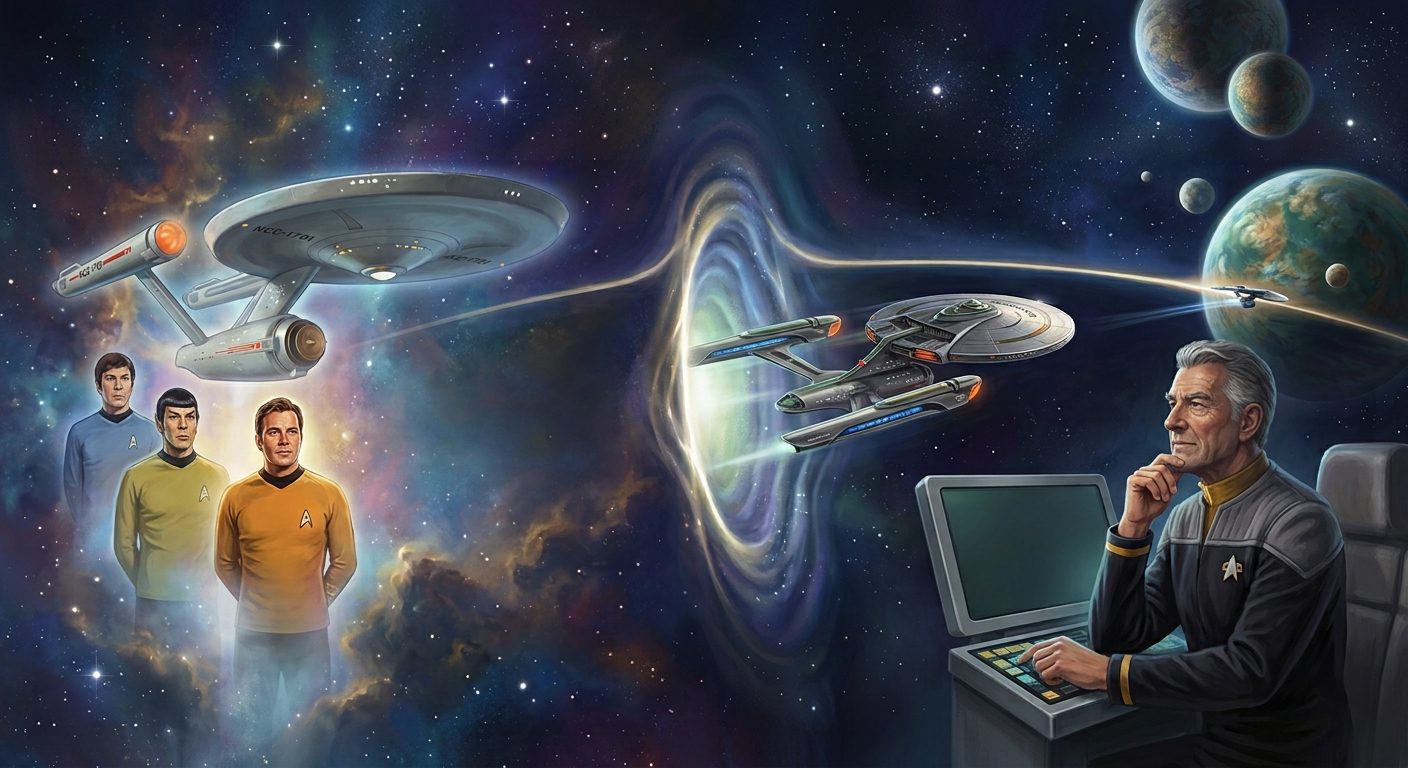
For as long as I can remember, Star Trek has represented something far greater than spaceships and distant worlds. At its finest, the franchise offers a vision of humanity’s future—not merely because of the technology we might someday invent, but because of the people we might someday become.
The original series inspired us to look beyond the horizon. The Next Generation challenged us to think deeply about diplomacy, ethics, and the profound responsibilities that come with exploration. Those stories weren’t simply adventures in space; they were narratives built on hope, curiosity, and the belief that understanding is always preferable to conflict.
Those foundational ideals became the primary inspiration for my own series, Star Trek: Horizon.
Returning to the True Heart of Space Exploration
When I began writing Star Trek: Horizon, I wasn’t interested in creating a bigger war or a more powerful enemy. Countless sci-fi stories already center on those tropes. Instead, I wanted to return to what made original science fiction special: the pure excitement of encountering the unknown.
Every Episode Begins with a Mystery
In Horizon, challenges aren’t resolved simply by firing a phaser or launching a photon torpedo. Instead, solving a crisis requires careful observation, patience, and the willingness to challenge long-held assumptions.
Throughout the journey, Captain Jonathan Ward constantly reminds his crew—and the audience—of a simple governing principle:
“Accept nothing. Question everything.”
That core philosophy serves as the anchor for the entire series.
Questioning Assumptions in the Unknown
Time and again, the crew of the Horizon discovers that their initial assumptions are flawed:
- Reevaluating Threats: What initially appears to be a hostile force often turns out to be a desperate plea for help.
- Expanding Boundaries: Phenomena that seem impossible are simply concepts humanity has never encountered before.
- Scientific Growth: Rather than discarding the laws of science, the crew expands their understanding as new discoveries push the boundaries of known space.
Real explorers aren’t people who already have all the answers—they are the ones willing to admit when they don’t.
Curiosity Is Stronger Than Fear
This philosophy extends well beyond science. The alien civilizations encountered in Star Trek: Horizon are rarely divided into black-and-white heroes and villains. They are complex societies with rich histories, deep-seated fears, and valid reasons for their choices.
While those choices occasionally lead to friction, they more often present an opportunity to listen before judging and to understand before acting. These lessons are just as vital today as they will be in the twenty-fifth century.
If readers take anything away from Star Trek: Horizon, I hope it is this: curiosity is stronger than fear. Questions are far more valuable than assumptions, and the greatest discoveries are not always the new worlds we find, but the new ways we learn to see one another.
Every great journey begins with a single decision—to venture beyond the familiar and discover what lies beyond the horizon.